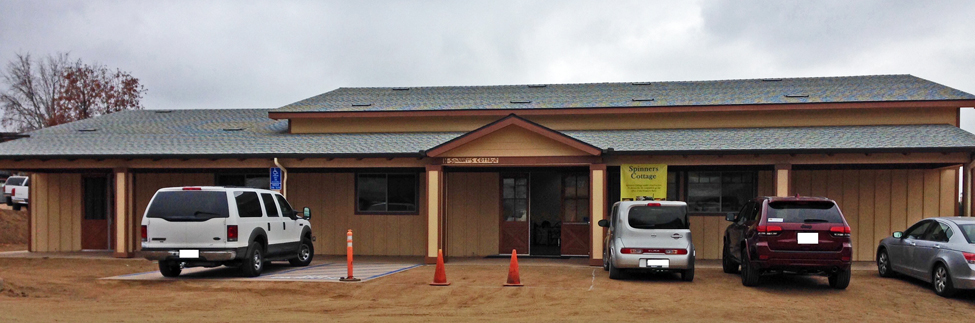
Low horizontal building with overhang held by posts. Four cars parked in front, one on left, three on right.
images for issues
Low horizontal building with overhang held by posts. Four cars parked in front, one on left, three on right.
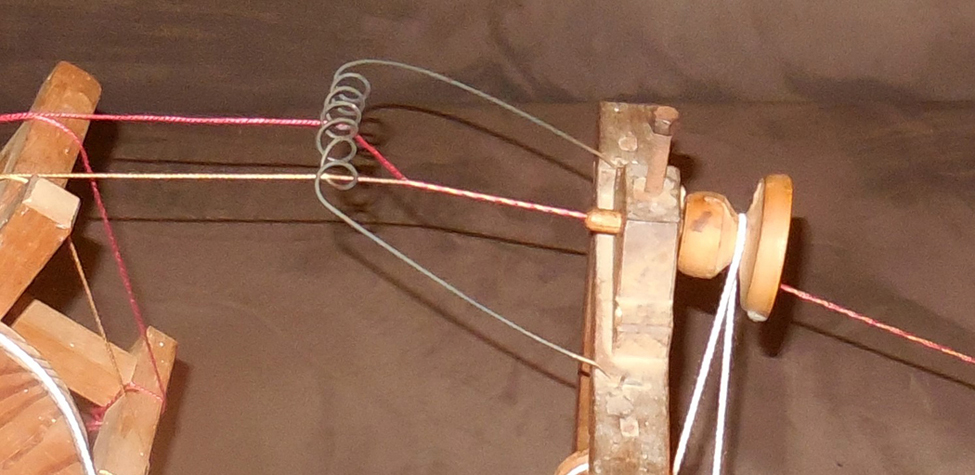
Detail of top of right side posts showing flyer-type knob that holds unmoving orifice with red and white threads coming through the orifice twisted and going into separate loops on the wire.
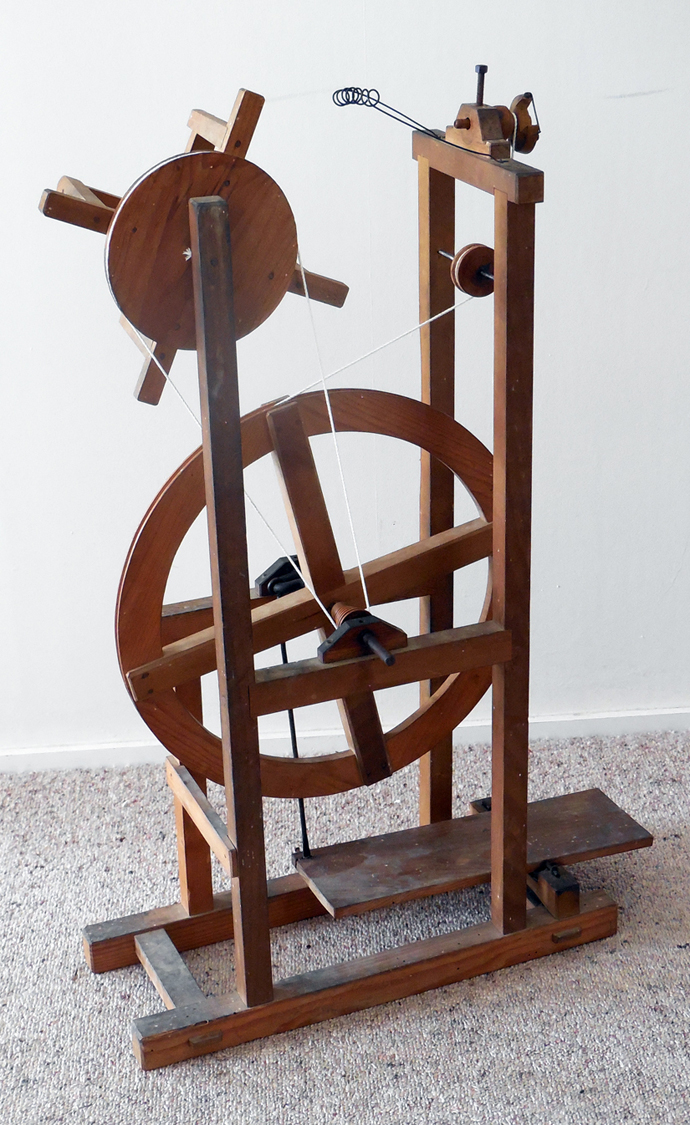
Rectangular wooden frame holds two vertical posts on right and one full height and one half height on left; treadle on right side; crosspiece between right and left in back and front holds the axle for the drive wheel with four spokes; top of left post holds disk with rim to which is attached a reel. Between the two posts on the right is a rod with a pulley about a quarter way down. A crossbar joins the two right side posts. On top on the right side is a wooden flyer type piece that goes around an unmoving orifice. On the other side facing the reel is a U-shaped wire bent into a series of six loops.

Horizontal single bobbin/flyer spinning wheel has a table with three legs, a treadle, a drive wheel with twelve spokes and a narrow rim, a brace behind each slanted wheel support post. The turnings on the legs, wheel support posts, maidens and spokes are fairly simple. Set on a braided rug with a woodstove in the background.
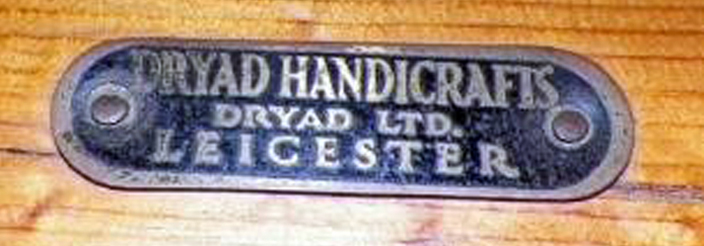
Elliptical metal plate with the words
“Dryad Handicrafts –
Dryad Ltd. –
Leicester”.
Two nails attach it to table.

Two horizontal single bobbin/flyer spinning wheels; each has a table with three legs, a treadle, a drive wheel with twelve spokes and a narrow rim; braces are behind each slanted wheel support post. The turnings on the legs, wheel support posts, maidens and spokes are the same on both wheels. They are placed on grass.

Objects from ATHM (American Textile History Museum) now at Marshfield School of Weaving. The objects shown are at least 12 spinning wheels of various constructions and designs, including several great wheels.
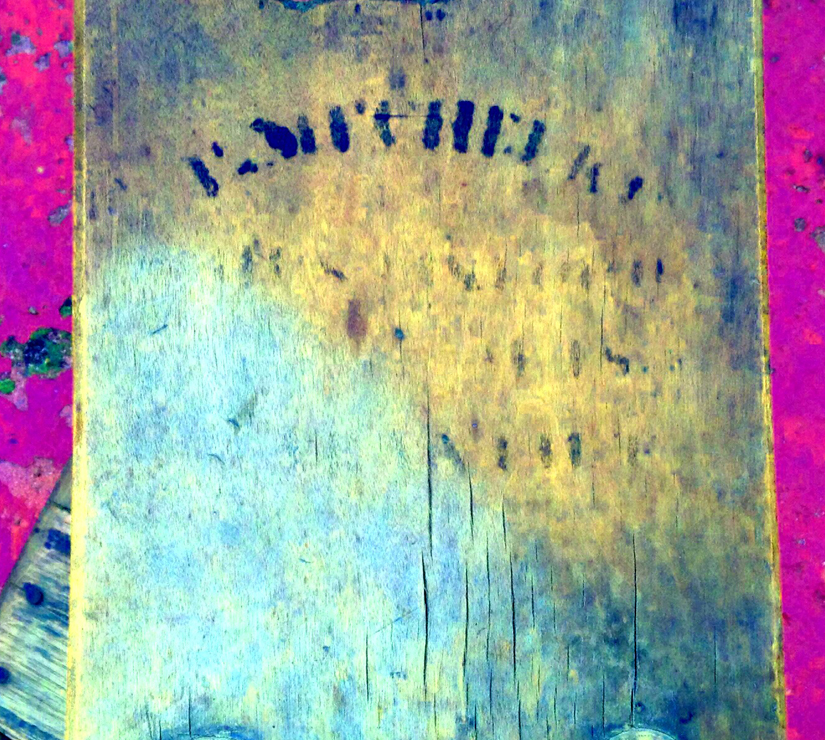
DStretch enhancement of the stencil markings, with the exaggerated “psychedelic” coloring that is characteristic of the program. The yellow in the wood is greatly enhanced, providing contrast to the black letters.
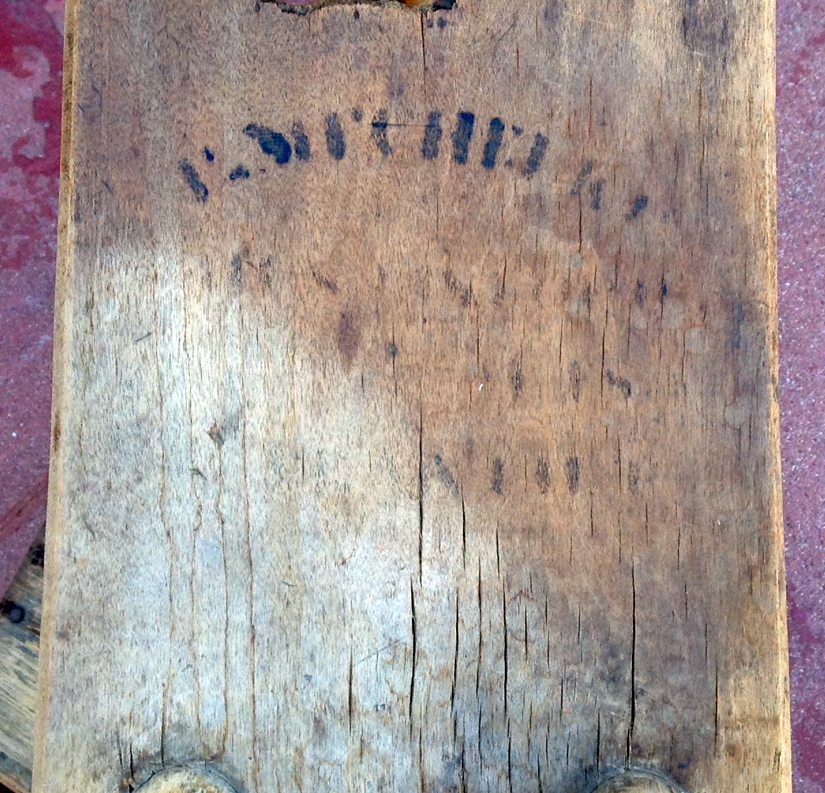
Water-damaged stencil markings on the table of the Ernst Mechelke German-style flax wheel. A dark band of unreadable text arches over three or four lines of lighter (and even more unreadable) text.
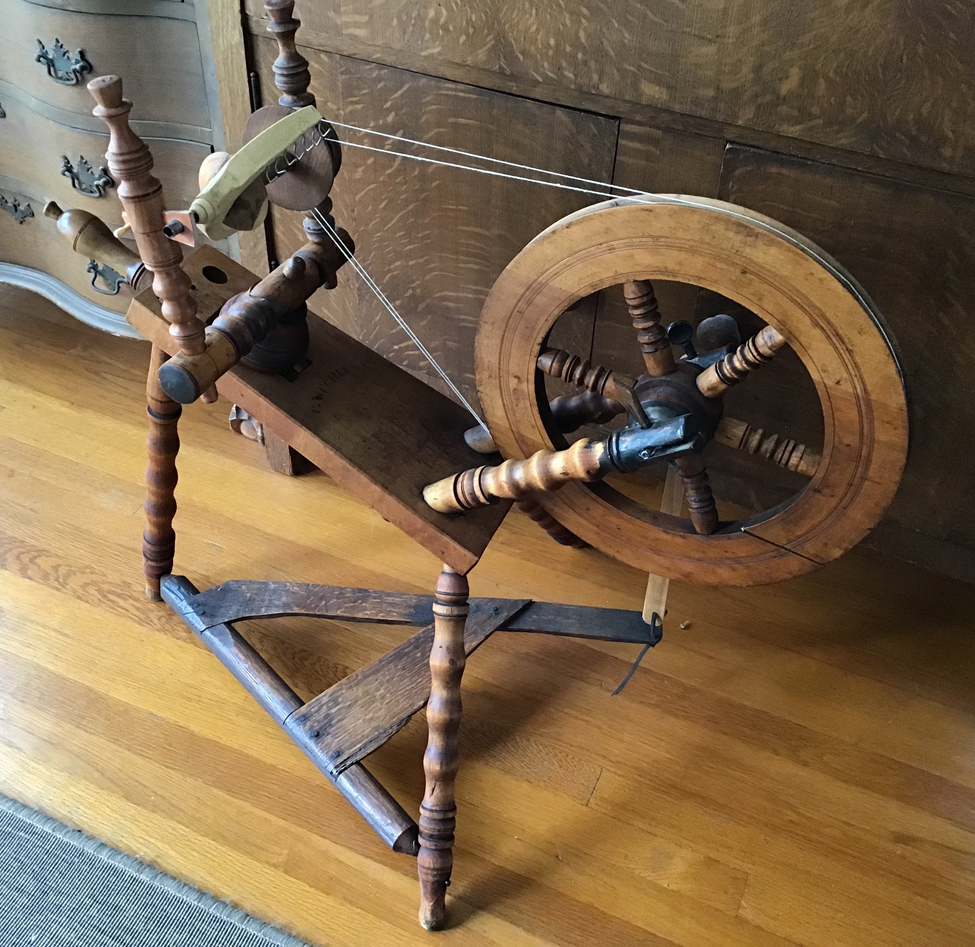
Restored Ernst Mechelke German-style flax wheel. Single treadle bobbin and flyer wheel with an angled table and a simple, 6-spoked drive wheel.
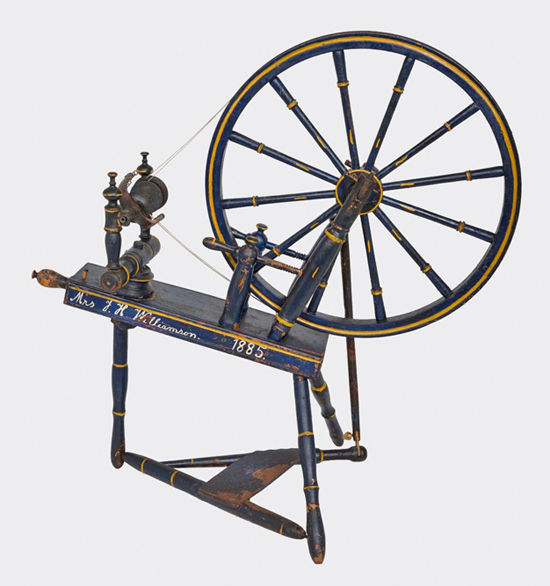
A painted example of Style #1 belonged to Mrs. John H. Williamson, who lived on the Tordenskjold farm in Burk Township, Minnehaha County, South Dakota, in 1885.
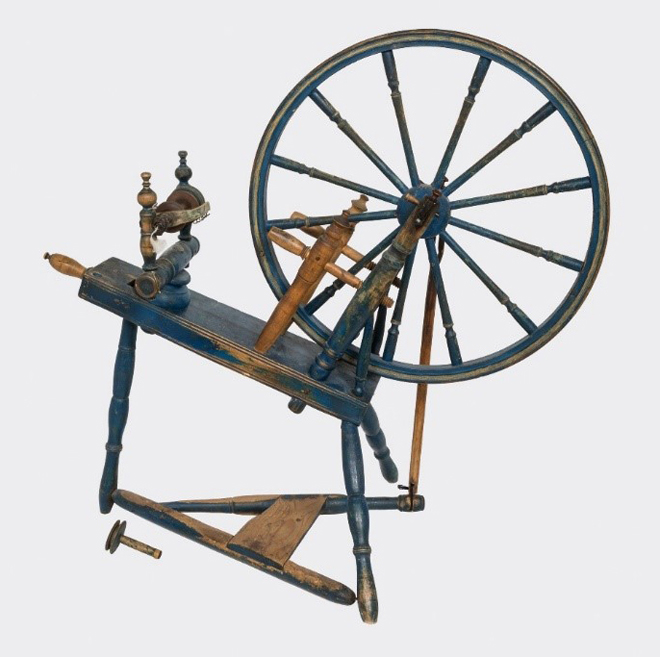
Gylland spinning wheel Style #3 is a rare hybrid wheel with both the canting screws and braces behind the uprights. It is marked AEG.
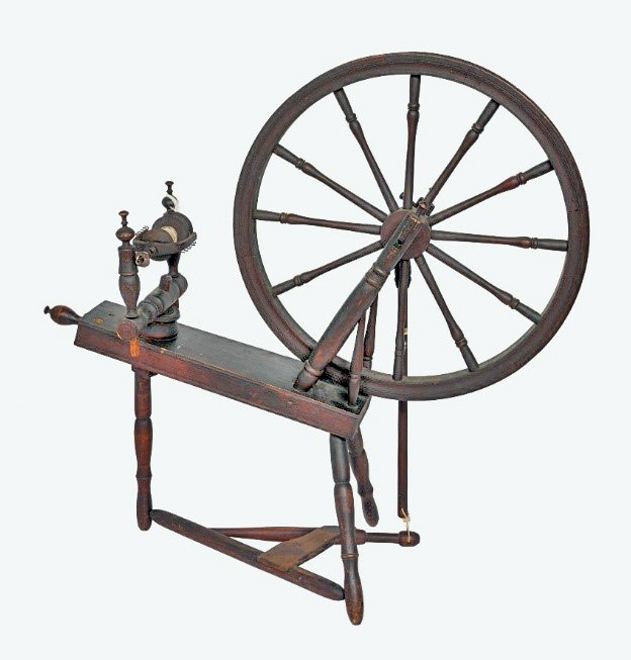
Gylland spinning wheel Style #2 has the same basic structure as Style #1 but has only one pair of uprights to support the drive wheel, with a reinforcing brace behind each of the uprights.

Gylland spinning wheel Style #1. A horizontal treadle wheel with a bobbin/flyer and drive wheel on a tapered, rectangular table. Four uprights: two short uprights toward the mother-of-all and two tall uprights support the drive wheel. A canting screw connects the short and tall uprights. It is marked OEG
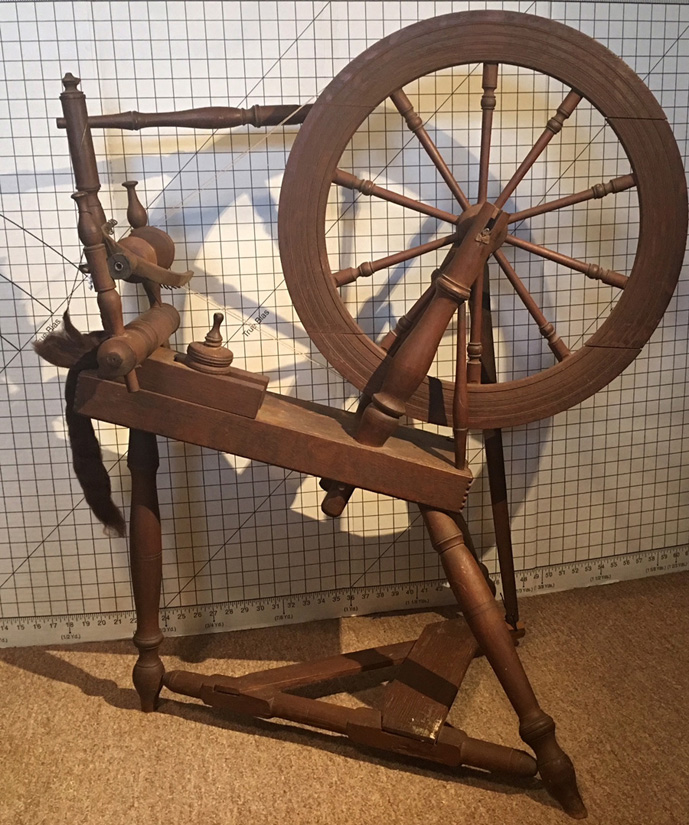
American style horizontal treadle wheel with mother-of-all set into a block of wood on top of table.
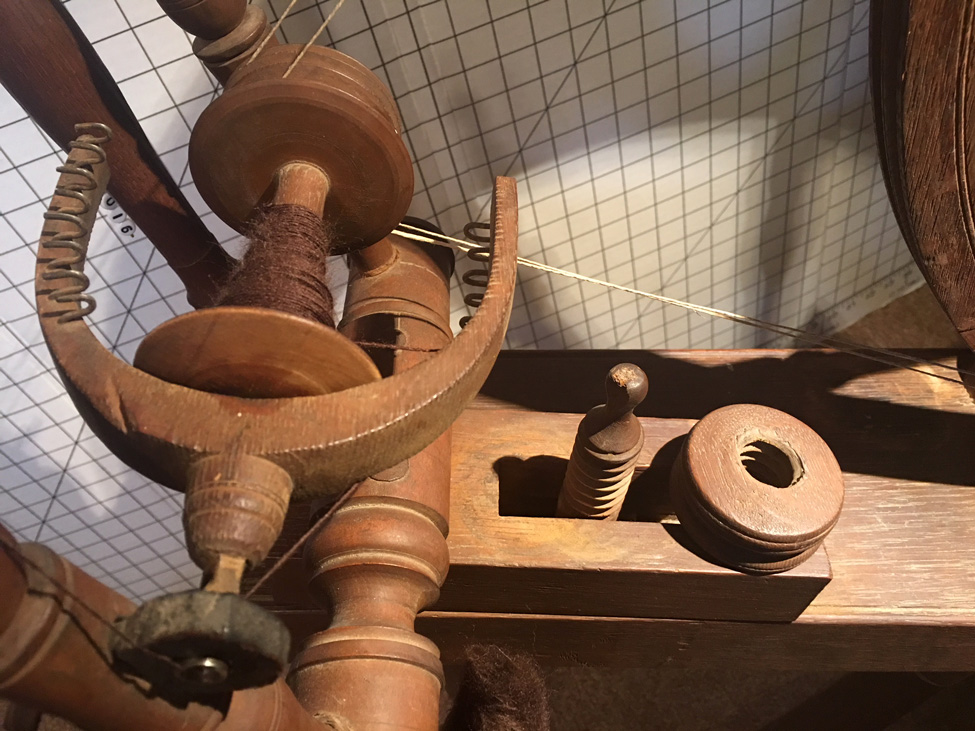
Detail of mother-of-all and tension adjustment on American style horizontal treadle wheel.
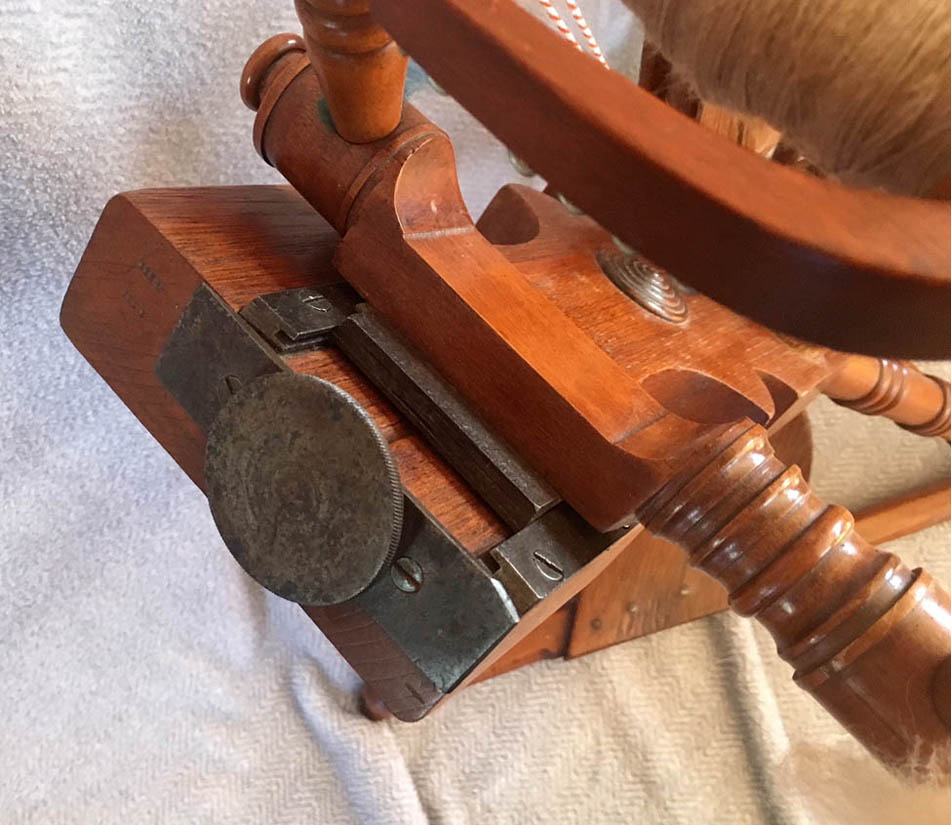
Detail of table end of Norwegian spinning wheel. Shows metal tension screw and sliding metal plate under mother-of-all.

Norwegian spinning wheel with extremely slanted table, with sliding metal tension system.
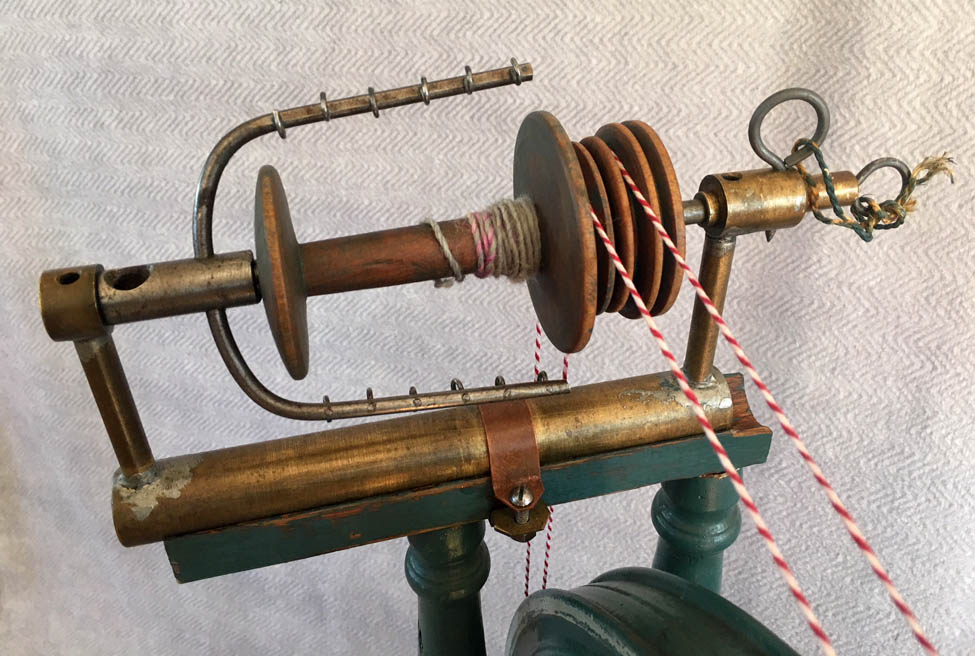
Detail of mother-of-all on upright wheel from Bergen, Norway. Mother-of-all is made with copper and brass.

Upright wheel from Bergen, Norway, painted teal and rosemaling on treadle and table, with metal mother-of-all.

Late “Hippy period” great wheel: detail of rocking tension device, which is a completely separate piece.
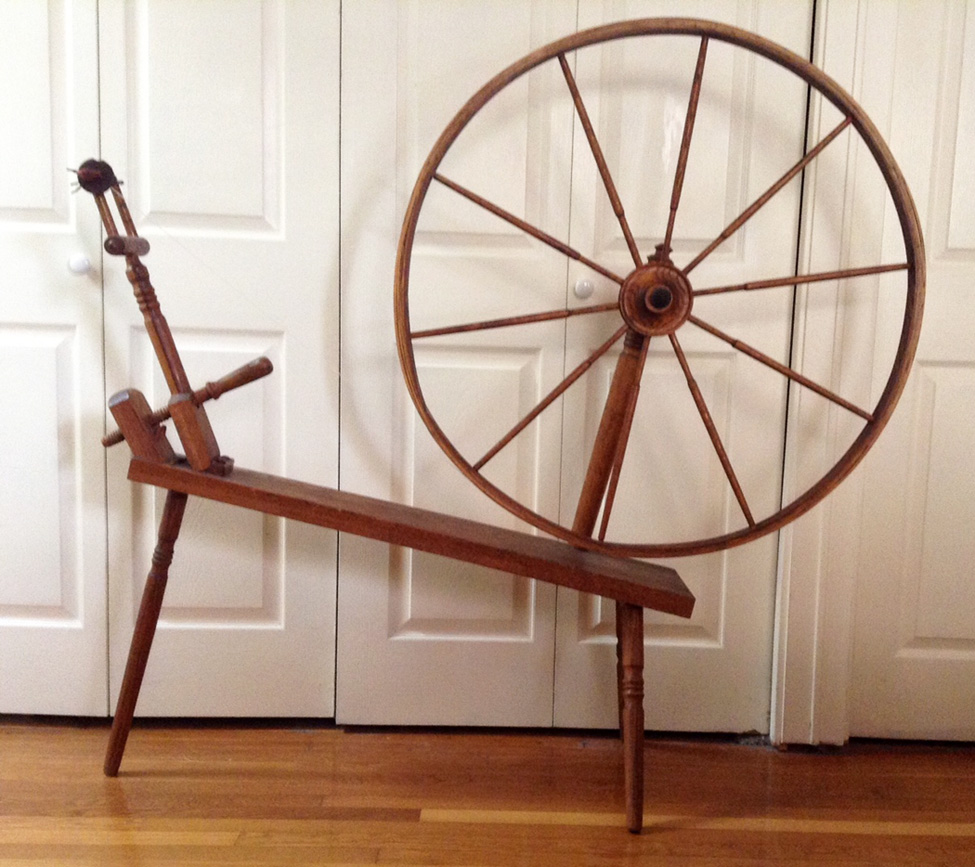
A very plain great wheel with direct drive spindle head, from late “hippy period.” The drive wheel has a thick rim.
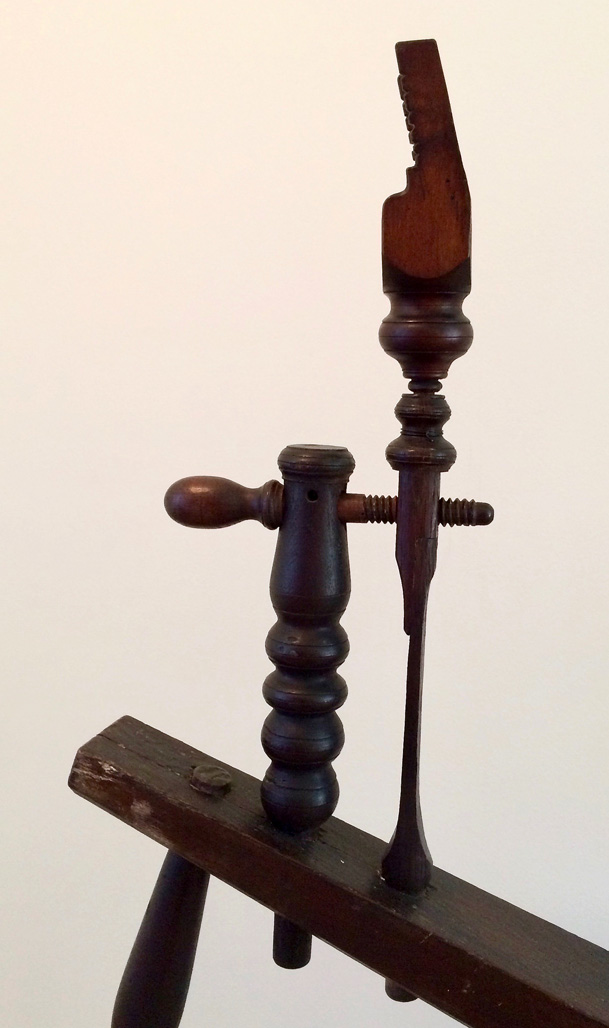
Detail of tension holder and spindle head holder on “Moon Over Spoon” wheel.

“Moon Over Spoon” great wheel, with curved table and finely turned tension holder and spindle post.

Detail showing distinctive turning on spokes and close spacing on drive-wheel hub.
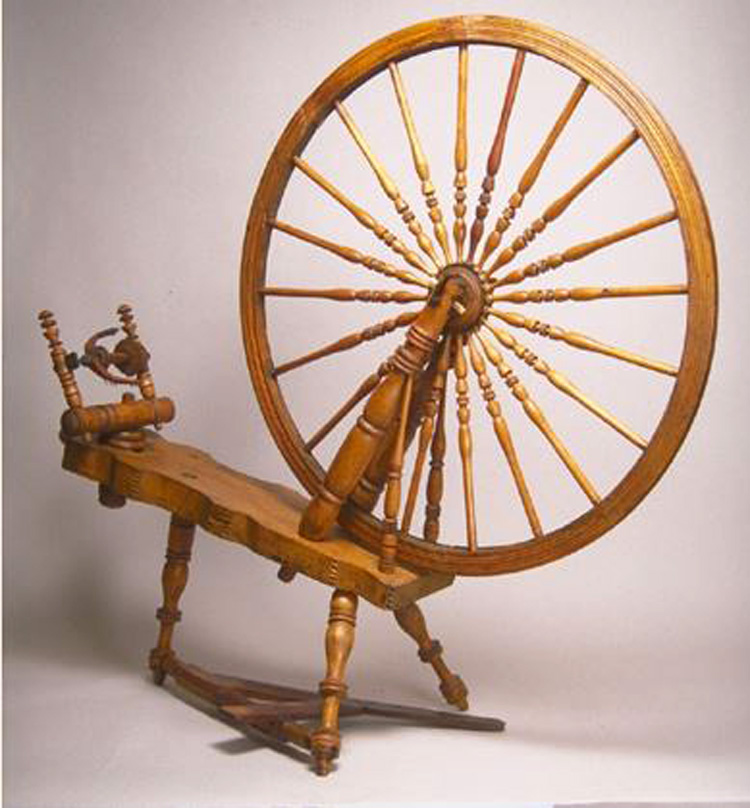
Cummer #94, horizontal treadle wheel with 36″ drive wheel with twenty spokes, all components have delicate turnings, curved table has chip carving on edges
Index to “The Spinning Wheel Sleuth” newsletter. Issues 1-98.

Model is a miniature: overall 7 ½”, 12″ long, 5″ wide, 4″ diameter drive wheel. Mounted on a wooden rectangle. Frame has three uprights two in the back that hold the drive wheel, and one in front. Bar between front and back frame holds end of a metal rod that goes to the floor where it connects with an accelerating head and a moving arm that holds a spindle head.
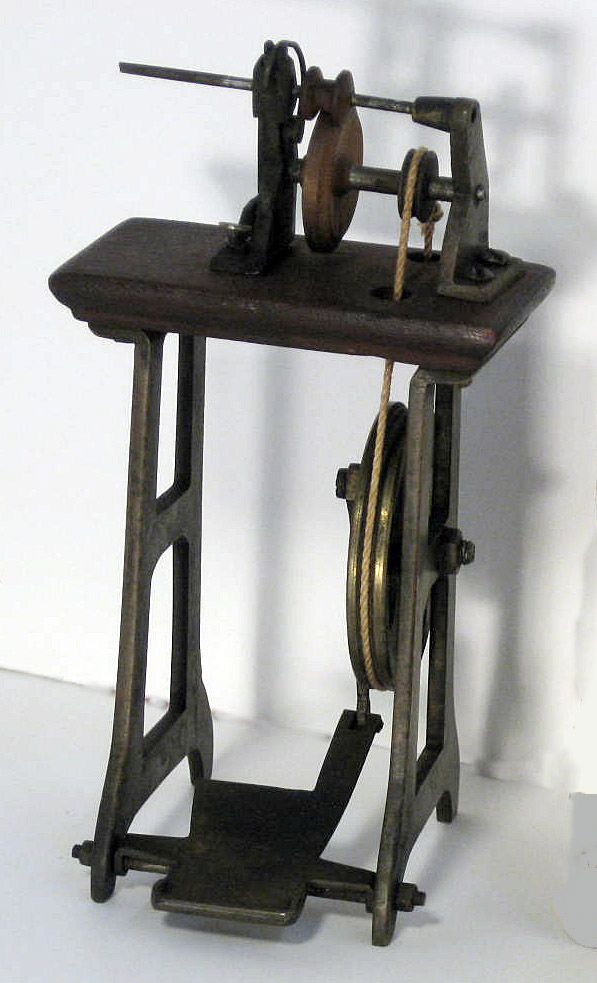
Model is a miniature: 1 ¼” wide, 2 ¼” deep, 3 ½” high. Two U-shaped metal sides hold a table top. A treadle is located between the front part of the legs. It is connected to a drive wheel attached to the right side of the frame. A drive band circles the drive wheel then goes through holes in the table top and around a pulley on a bar. The bar is located between two metal uprights. Another bar goes between the tops of these uprights. On the left side of the lower bar is another round piece of wood that rubs against the small wooden pulley on the top bar that makes the spindle at the end turn.
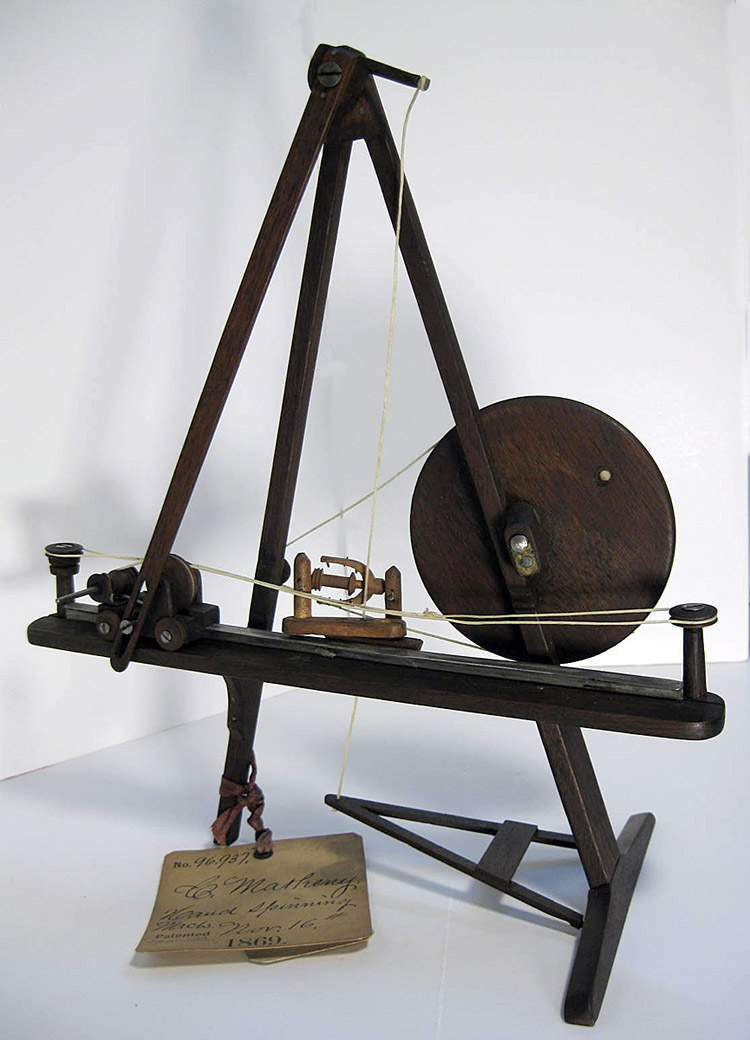
Model is a miniature: 11 ½” high, 11″ long, 5 ½” wide. Two vertical wooden frame elements meet at the top. A third piece goes down to a cross bar or track forming an A-shape. A treadle is attached to the right side of the frame and connects to a lever at the top. A wheel with a handle is also attached to the right hand side above the track. At each end of the track is a knob with a pulley. Cords run from the knobs to a spindle head on the track. A bobbin/flyer unit is also shown.
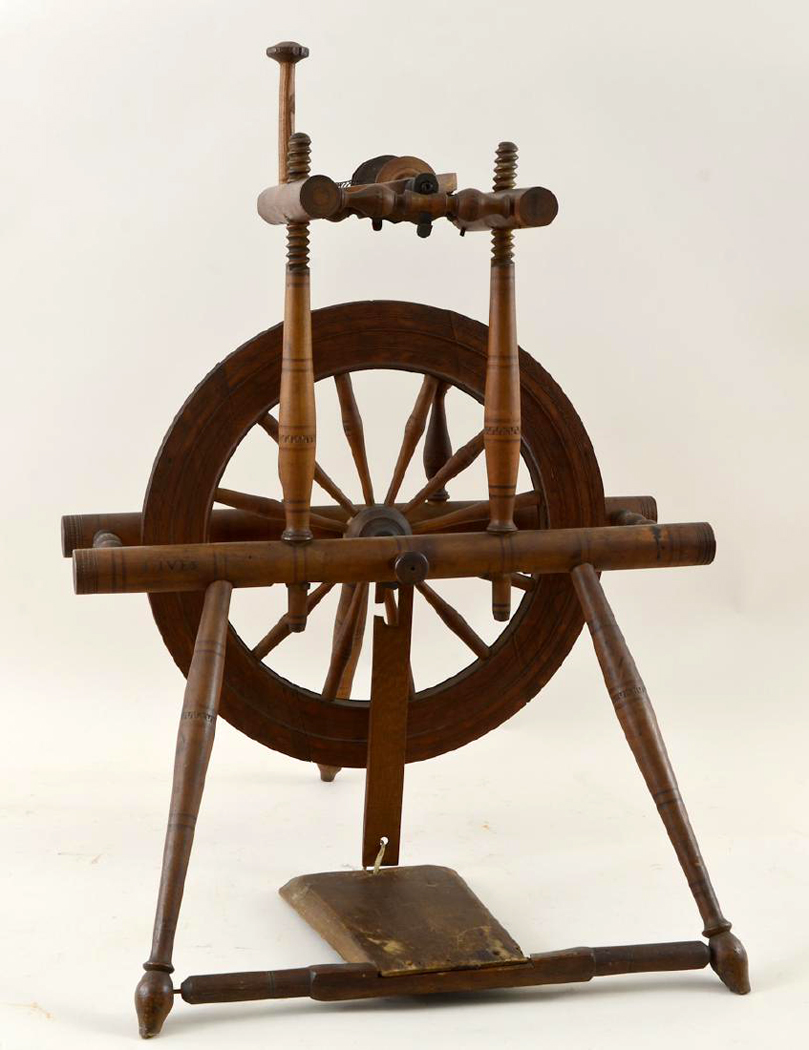
Simple spinning wheel: Three turned legs hold a rectangular frame of two long and two short, turned wooden rods that is 24 ½” wide and 15″ high from the floor. The drive-wheel diameter is 19″, and its axle rests between the two long, rounded elements of the frame. Two threaded rods fit into the front of the frame with the bobbin and flyer unit at the top. The height from the floor to the top of the tension screw is 29 ½”.

Horizontal treadle wheel with nicely turned spokes on the drive wheel and a slightly slanted table. Three parts of distaff are present and the top section is a flat piece of wood with curved cut-outs.
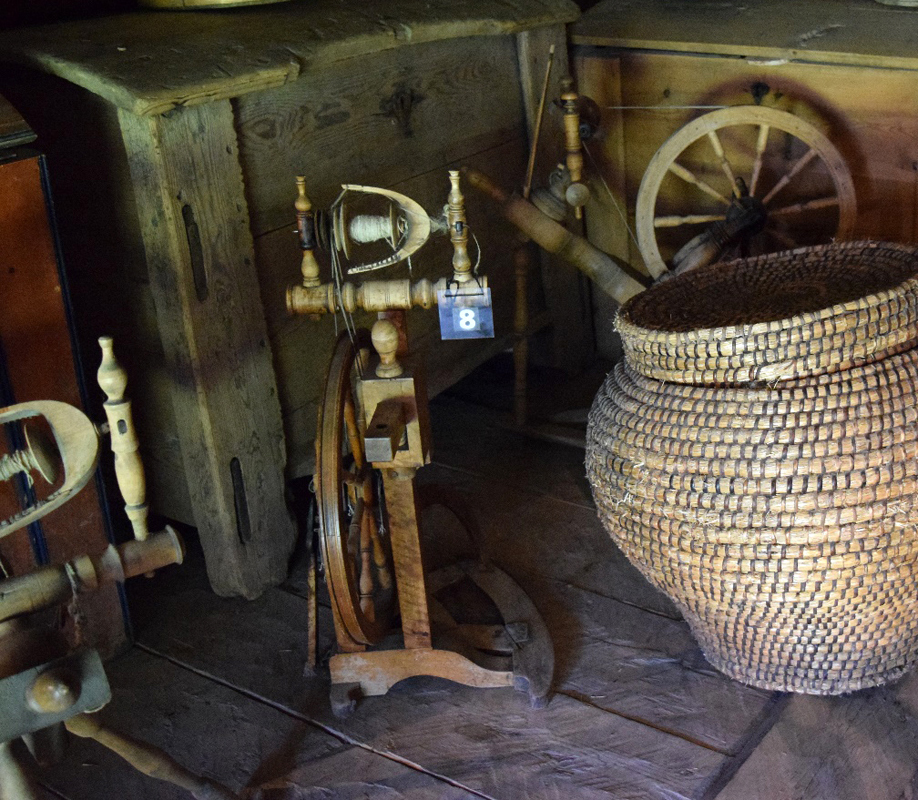
Spinning wheel in center is an upright wheel on a frame. Drive wheel is behind the frame, treadle is inside frame with bobbin/flyer unit on top.
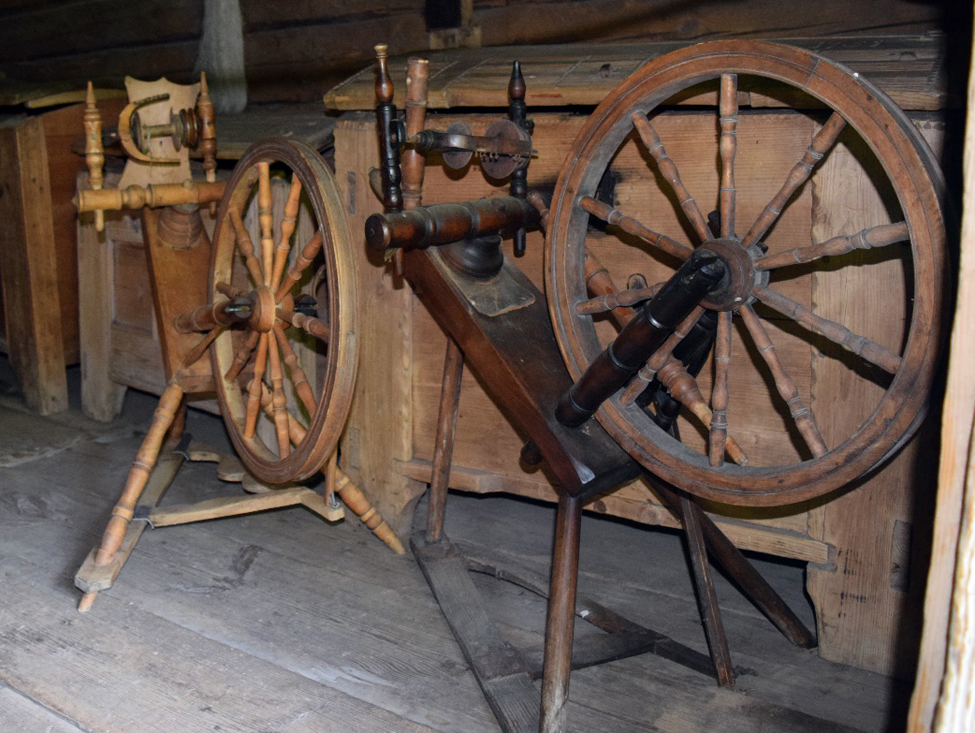
Two bobbin/flyer spinning wheels: Bobbin/flyer wheels with three legs and a treadle, and a spoked drive wheel. Tables are steeply slanted with two back legs fitting into the ends of the table. on wheel on left-hand side, drive-wheel supports are almost parallel to the ground, so have small braces for reinforcement.
Order form, issues in print, Dec 2017